
Halloween Week: Prevention Before, During, and After
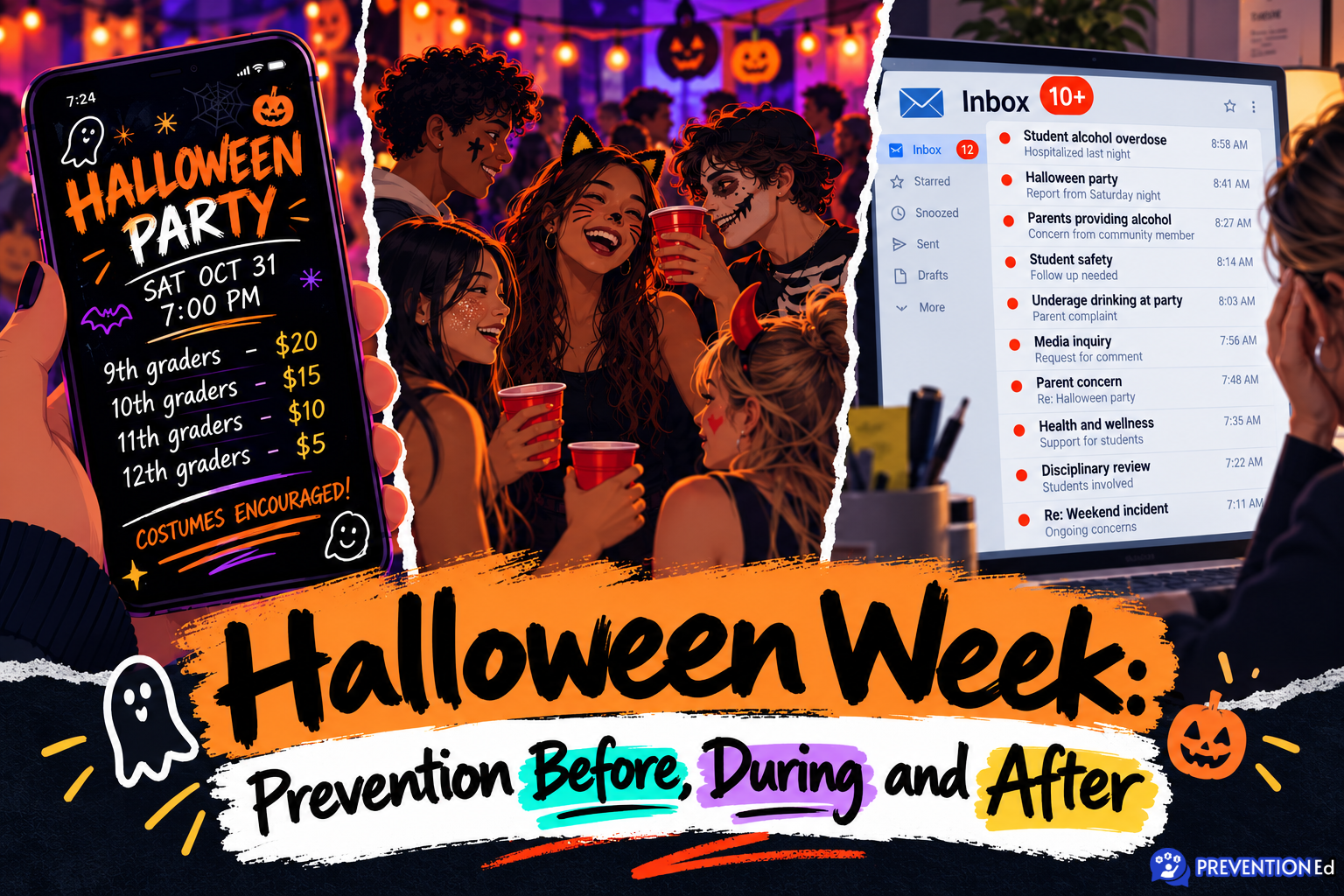
The last two weeks of October are Prevention Ed’s busiest of the school year. Schools around the world book us for the week before Halloween. The week after brings a different conversation: what went wrong at those parties.
A student was taken to the hospital with alcohol poisoning. Parents who rented an Airbnb for a party are now being sued for damage to the property. Other parents are angry that an adult gave their teenager alcohol.
Those are the stories a community hears about. Students carry another list, one most people never see: a blackout they can’t piece together; intimate photos shared without consent; a sexual assault; a friend left on a bathroom floor because no one knew what else to do.
When an adult provides alcohol to teenagers or a place for them to drink, or when a school becomes aware that a large group of students is likely to get drunk at a party, that is a child safeguarding issue and schools should treat it as one.
Here is what we recommend for the next two weeks. It applies to Halloween. It also applies to any student party that has become a tradition at your school, especially when alcohol may be there.
What students, parents, and schools can do.
For Students
1.Go to the party if you want to, and have fun. If you plan not to drink, have your reason before attending the party. It doesn’t have to be true, but your friends should respect it. If you don’t want to drink, you can say:
“I don’t like being drunk”
“I have to get up early tomorrow”
“I’m taking a medication that I can’t drink with right now”
“My parents are waiting up for me to come home”
2.Take a moment to notice how the space and people around you make you feel. Your brain may pick up on signs of risk before you can name them, and you feel that as a “gut feeling.” Your prefrontal cortex, the part of your brain that helps you assess situations and make decisions, uses that signal to figure out what to do. If something feels off, trust that gut feeling. Alcohol dulls both the warning signal and your ability to act on it, which makes it harder to recognize threats, notice when someone is acting inappropriately, or respond to an unsafe situation.
3. Know the signs of alcohol poisoning: When someone drinks to the point of severe intoxication and vomits, the vomiting is a symptom of alcohol overdose.
If someone at a party or in a bar shows any of these signs, call emergency services immediately. Don’t wait for them to show every symptom.
Vomiting
Slow breathing, fewer than eight breaths a minute
Irregular breathing, with gaps of more than 10 seconds
Pale, blue, or clammy skin
Low body temperature
Passing out or can’t be woken up
While you wait for help
Do:
Call emergency services immediately.
Call an adult you trust. Don’t delay calling emergency services while you do this.
If they are unconscious or lying down, gently roll them onto their side into the recovery position to help prevent choking.
Stay with them and watch their breathing.
If they stop breathing normally, follow the emergency operator’s instructions and give CPR if you can.
Don’t:
Try to “sober them up” with bread or other food. Food won’t absorb alcohol that’s already in their bloodstream.
Give them anything to eat or drink. They could choke.
Put them in a cold shower. They could fall or drown, and alcohol makes it harder for the body to regulate its temperature. Cold exposure can put them at risk of hypothermia.
Try to make them vomit. They could choke or injure their throat.
Leave them alone to “sleep it off.” Their blood alcohol concentration can continue to rise after they stop drinking, slowing or stopping their breathing.
Send them home alone in a taxi or rideshare.
4.If you go to a party, whether or not you drink, and something about the night is bothering you, tell an adult you trust. You could talk with a parent, school counselor, or advisory teacher. It can feel difficult to ask for help, especially if you’re worried about getting in trouble or being judged. But keeping you safe and helping you get support are adults’ responsibilities. You don’t have to figure out what happened or what to call it before reaching out. If talking face-to-face feels hard, check whether your school has an anonymous tip form or another way to ask for help.
5.Taking a pill or powder when you aren’t 100% sure where it came from is the biggest risk you can take right now. Counterfeit pills are the #1 way teens are exposed to fentanyl. They can look like real prescription medicines but contain fentanyl, a powerful opioid. Fentanyl has also been found mixed into powdered drugs such as cocaine and ketamine. You can’t tell by looking, tasting, or smelling whether a pill or powder contains fentanyl. A familiar-looking pill or unknown powder can cause a fatal overdose.
You should be able to have fun, socialize, and celebrate. We also want you to understand the risks and have the information you need to make the healthiest choice for you, whether that means choosing not to drink, reducing risk if you do, or knowing how to care for a friend.
To learn more about the stages of intoxication and what to do if someone is experiencing an alcohol overdose, watch Prevention Ed’s Short: Understanding Alcohol's Impact on the Brain and Safety Strategies for Young People
For Parents
“They’re going to drink, so I’d rather have them do it here” is a common justification parents give for allowing teenagers to drink. But most teens are not drinking. Over the past 25 years, the percentage who reported drinking in the past 12 months dropped from 43% to 11% among 8th graders, 65% to 24% among 10th graders, and 73% to 41% among 12th graders. Adults’ perceptions of teen drinking may be shaped by their own experiences as teenagers. Today, most young people report choosing not to drink.
Another piece of misinformation is that supervised drinking teaches teens to drink responsibly. The concept is well-intentioned; it comes from a place of wanting to protect your kids, but research does not support it. When parents permit adolescent drinking, teens tend to drink more often, consume more, and experience more negative consequences (Journal of Studies on Alcohol and Drugs). Rather than reducing harm, parental permission introduces it.
The table below compares the negative consequences reported by students who drink 5 or more drinks in one night (Higher-Risk Drinker) with those reported by students who drink 1–2 drinks (Lower-Risk Drinker).
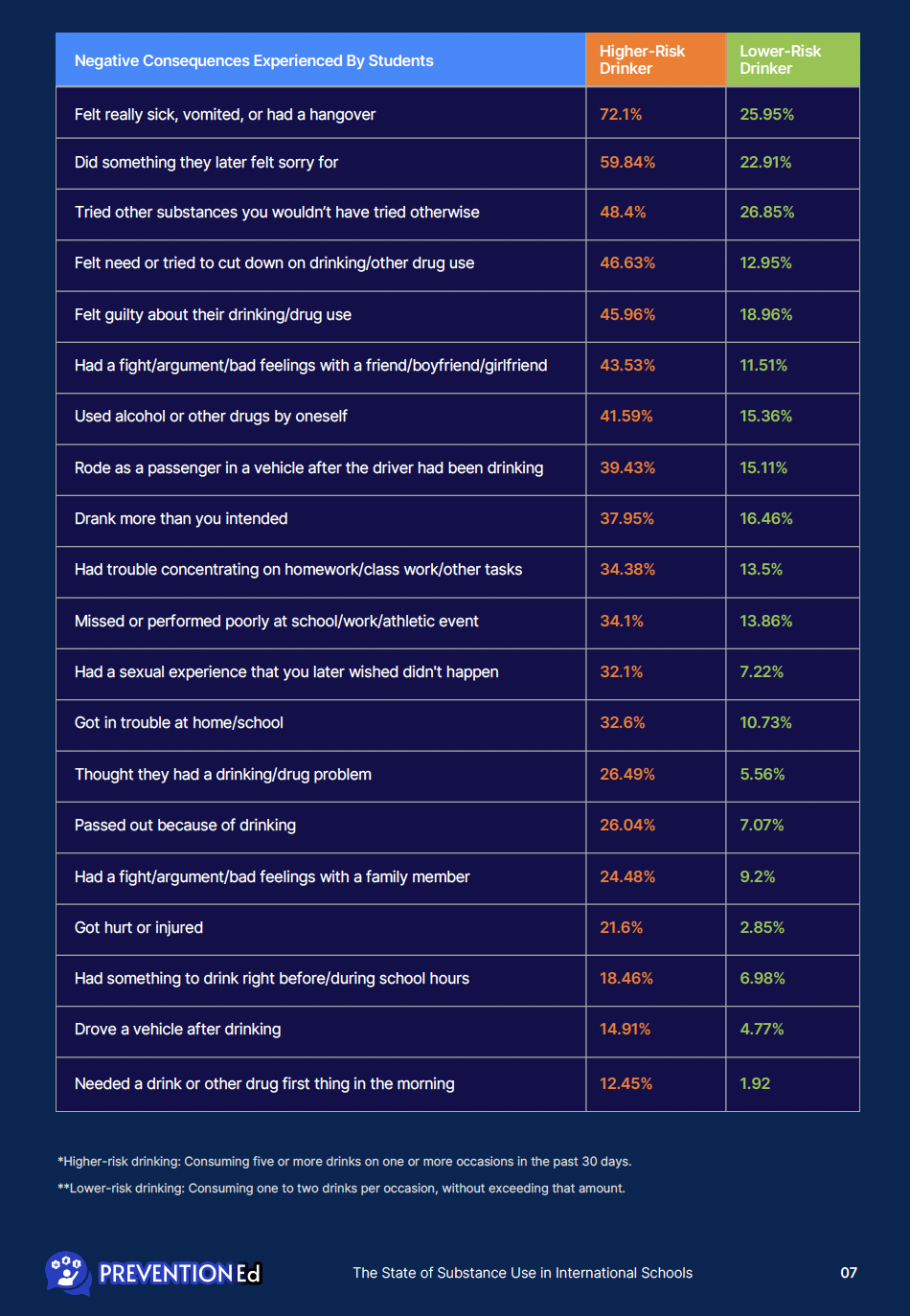
Prevention Ed. (2025). The State of Substance Use in International Schools: Global Insights From Prevention Ed’s Student Substance Use & Peer Perception Survey (2023–2025). https://www.preventioned.org
These numbers can be hard to look at, but they matter. We are trying to prevent more than addiction. We also want to prevent the immediate harms that can follow one night of drinking.
Here are some steps you can take to help keep your child safer:
Don’t host a party where you provide alcohol or a space for teens to drink. We can’t prevent everything, but that doesn’t mean we should make drinking easier. Research suggests that providing alcohol can have the opposite effect from what many parents intend. A party at home doesn’t make drinking safer.
There is power in numbers. In our experience, when we ask parents if they would welcome a call from another parent asking whether alcohol will be present at a party, nearly every hand goes up. When we ask who feels comfortable making that call, far fewer hands go up. A single call from a concerned parent may be easy for the host to brush off. But when ten parents reach out to ask whether alcohol will be present, the host may reconsider providing it or a place for teens to drink. Making that call can feel uncomfortable, but we can push past the discomfort and make checking in with one another a community norm its a protective factor for our kids.
Plan what you’ll say before the party. Don’t wing it. A brief, calm conversation can reinforce your expectations about alcohol and other drugs and explain the consequences if your teen chooses to drink or use.
Ask three questions about any party: Where is it? Which adult will be home? Will there be alcohol? Then call the host.
Stay up and wait for them. Let your child know you’ll be awake when they get home. Greet them with the old fashioned hug-and-sniff test. Kids report drinking less or being less likely to drink when they know their parents are waiting for them to come home.
Give your child a way out. Agree on a text, it can be one word “banana” or emoji 🤡 whatever your family decides that means “come get me now.” Pick them up, and let them know they don’t have to talk about it that night, but you’ll talk within 24 hours.
These steps help your teen understand your expectations and know they can come to you if something feels unsafe. When parents communicate and look out for one another, we create a stronger safety net for young people.
For Schools
School staff are often among the first adults to hear about a major student party. Students may think they’re the only ones who know, even when they’ve been talking about the plans for weeks. You may already know where the party will be, whether alcohol is expected, what students are paying to get in, and sometimes which adult is providing it.
That information gives schools a chance to prepare. Data on student-reported consequences show that one night of drinking can have a serious impact on students’ safety and well-being. When alcohol may be available at a large student party, it’s a child safeguarding concern. A few thoughtful steps before and after the event can help students make safer choices, know how to get help, and feel supported if something goes wrong.
Contact families ahead of the event. Send a letter one to two weeks beforehand. Remind families of the school’s alcohol and drug policies. If you know a party is planned at a public venue and are concerned alcohol will be provided, say so directly.
Invest in student prevention. Give students time to talk about the risks, practice what they might say, and learn how to get help for themselves or a friend. Prevention Ed can lead student sessions to help schools prepare students for real situations they may face. Or share the student information above with students the week before the event.
Involve the school nurse. Ask the nurse to teach students how to recognize alcohol poisoning and respond while help is on the way, including placing someone in the recovery position and learning CPR. Reinforce what to do and what not to do. Make this a required advisory lesson.
Make it safe for students to ask for help. Tell students clearly that they can call for help for themselves or a friend without being disciplined for making that call. Make sure they know whom to contact and how to reach them, including whether the school has an anonymous reporting system.
Separate support from discipline. Schools need clear pathways for responding to alcohol and other drug use. One should focus on immediate safety, health, and support. The other should address policy violations. Explain both pathways to students and families so students understand that the school treats substance use as a health concern, not only a disciplinary issue.
Ask coaches to review the athletics department’s alcohol and other drug policy with student-athletes before the event. Coaches should clearly communicate the policy, expectations, and consequences.
Plan now for the week after the event. If something does go wrong over the weekend and a school event involving alcohol. Have counselors check in with students who were involved. Keep support conversations separate from discipline decisions.
Keeping students safe is our shared responsibility and our first priority. Nurses, advisory teachers, coaches, and other trusted adults can help students look after themselves and one another, feel safe asking for help, and get support when they need it. School leaders can set clear expectations with parents and hold adults accountable for providing alcohol or a place for teens to drink. When adults act together, students know that their wellbeing matters and that they can count on us.
Explore related resources and blogs from Prevention Ed:
Parents' Permissiveness with Alcohol: A Child Safeguarding Issue
Prevention Ed Blog: Understanding and Addressing the Link Between (Affluent) Neglect and Adolescent Substance Use.
Prevention Ed Blog: Teaching Teens How to Drink? Hold My Beer.
Alcohol